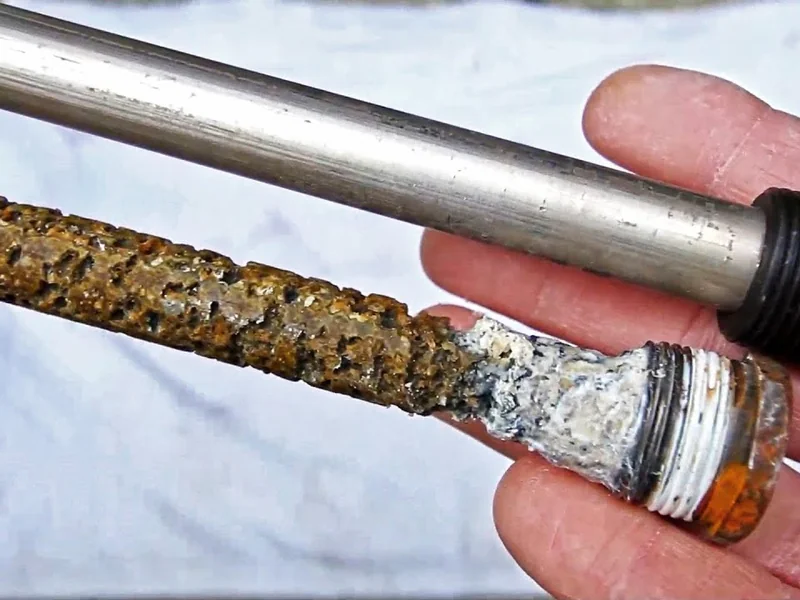
Hanahan sits right against the Naval Weapons Station, and that shapes everything about its housing. Military families rotate through on PCS orders, homes turn over every few years, and a remarkable share of the 29410's 1970s-through-1990s subdivisions are rentals or recent purchases. In a community where water heaters change owners as often as the houses do, the anode rod — the sacrificial metal rod inside the tank — is almost always neglected.
The rod's job is simple: corrode so the steel tank does not. On Hanahan's municipal supply, a magnesium rod lasts three to four years. In a town where the average homeowner tenure is measured in PCS cycles, that means most tanks are running on rods that died two owners ago — with corrosion quietly working on the tank itself the entire time.
We replace anode rods across Hanahan, from the neighborhoods along Remount Road to the subdivisions near the station gates. Every visit includes a documented tank health check — records that matter at sale, at turnover, and at the next PCS move.
PCS Turnover and the Most Neglected Rods in the Lowcountry
In most suburbs, a water heater has one owner who either maintains it or does not. In Hanahan, a single tank may serve three or four families in a decade — and none of them owns the maintenance history. The result is the most neglected anode rods in our service area: original magnesium rods, installed a decade ago, consumed within four years, with the tank running unprotected ever since.
The chemistry is unremarkable — Hanahan's municipal supply is moderately hard, and a magnesium rod lasts its textbook three to four years here. The problem is purely human: nobody checks. PCS moves, rentals, and quick sales all conspire against the kind of boring preventive maintenance that keeps tanks alive. By the time sulfur odor or rusty water prompts a call, we are often pulling out a bare wire where a rod used to be.
The turnover protocol
For Hanahan's military families, we recommend a simple rule: rod check at every PCS move, inbound or outbound. Inbound, it tells you what you just bought — a healthy tank with a fresh rod is an asset; a dying tank with a dead rod is a negotiation point or a budget item. Outbound, a fresh rod and documented service is a listing advantage. Either way, the inspection costs little and the information is worth real money.
- Frequent turnover: tanks serve multiple families, none maintaining the rod
- Rental stock: rods neglected for a decade or more is common
- 1970s–90s subdivisions: second-generation tanks now in the critical 8–14 year window
- Water softeners: common locally, shorten rod life to 2–3 years
Selling Soon? The Rod Service That Pays for Itself at Closing
Hanahan's housing age puts a huge share of its water heaters in the decision window: tanks at eight to fourteen years old, where the rod question and the replacement question arrive together. Here is our honest framework.
Replace the rod when: the tank is under ten years old, the shell is clean with no base rust, flush water runs clear, and the symptoms are odor or a known-depleted rod. A fresh rod plus a flush in a sound mid-life tank can add three to five years — and in a Hanahan home you plan to sell or rent, those are documented, valuable years.
Consider replacing the tank when: the unit is past twelve years with base rust, rusty flush water, or weeping fittings. A new rod cannot rebuild breached lining. And if you are selling, a new tank with a fresh warranty is a stronger listing feature than a maintained old one — we will give you the straight math on both options.
What sellers should know
Home inspectors in the Charleston market flag water heaters aggressively — age, condition, and signs of neglect all show up in inspection reports. A Hanahan seller with a fresh rod service and a documented tank health check neutralizes that entire line of negotiation. The service costs a fraction of the credit a buyer will demand for a flagged tank, and it signals a maintained home in a way buyers notice.
Sulfur Odor in Hanahan Tanks: Diagnosis Before Dollars
The most common Hanahan service call is the sulfur smell: hot water that reeks of rotten eggs while the cold runs fine, usually in a tank nobody has serviced in years. Sulfate-reducing bacteria colonize the warm tank and react with the depleted magnesium anode, producing hydrogen sulfide gas.
The fix is a zinc-aluminum alloy rod plus a full tank flush. The alloy feeds odor bacteria far less than magnesium, and the flush clears the bacterial film and sediment they shelter in. Most Hanahan homeowners notice the smell fading within a week or two of normal use.
Ruling out the supply
We test both taps on every odor call. Hot-side-only odor means the heater is the source and the rod is the fix. If the cold water smells too, the source is upstream and a rod will not solve it. That five-minute test prevents the most common misdiagnosis in water heater service — and in a turnover-heavy market like Hanahan, where the last owner might have masked symptoms, verifying the actual source matters.
One caution for older Hanahan tanks: if odor arrives with rusty water or rumbling sediment in a tank past ten years, the rod may have been gone so long the tank is compromised. We will tell you honestly when the symptoms point past the rod.
Tight Closets and Seized Rods in Hanahan's Subdivisions
Hanahan's subdivisions were built in the era of the garage-corner water heater — tanks boxed in by storage, tucked into utility closets with shelving overhead, or set in low crawl spaces. A rigid three-foot anode rod needs three feet of clearance above the tank to install, and many 29410 installations do not have it.
Segmented flexible rods solve this completely. The linked sections bend as they feed into the tank, installing with just inches of headroom, and protect exactly like a rigid rod once seated. We carry them on every Hanahan call because tight 1970s and 80s layouts are the norm here.
Seized rods in long-neglected tanks
The bigger Hanahan challenge is neglect duration. A rod untouched for twelve years in a humid garage often has its hex head fused to the tank nipple. We break seized heads free with penetrating treatment and controlled leverage — never brute force, which risks twisting the tank's internal fittings or cracking the nipple. Then we inspect the threads before seating the new rod, because a damaged nipple will not seal properly.
We also drain several gallons before breaking the old rod loose, dropping the water level below the rod port. Skip that step and the work area floods the moment the rod breaks free — a mess we avoid every time.
Local Insight
Hanahan is a Navy town. The Naval Weapons Station dominates the local economy and the local housing market, and the 29410's subdivisions — built heavily in the 1970s, 80s, and 90s — were designed for exactly the families stationed there: modest single-family homes on slabs or low crawl spaces, two-car garages, and water heaters in garage corners or utility closets. Many of these homes are now rentals serving the same military population, which means the water heaters serve a rotating cast of occupants who never stay long enough to think about maintenance.
That turnover is the defining local factor for anode rod work. A tank installed in 2010 may have served three families, none of whom ever had the rod checked. By the time the current owner calls about sulfur odor or rusty water, the rod has been gone for the better part of a decade. We see this pattern constantly in Hanahan: the symptoms are new, but the neglect is old.
The housing age adds a second layer. Hanahan's 1970s and 80s stock is entering the window where original-era tanks are long gone and second-generation tanks are aging out. A tank at year nine or ten with a fresh rod and a flush can still reach year fourteen; the same tank with a dead rod is living on borrowed time. And in a market where homes sell fast to incoming military families, a documented water heater service is a genuine listing asset — home inspectors flag neglected tanks, and a fresh rod with records takes that negotiation point off the table.