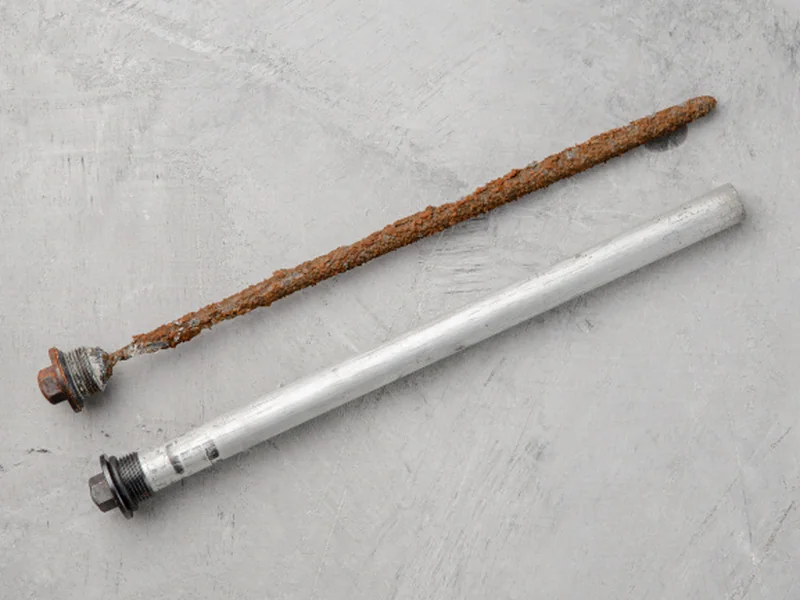
Most Awendaw homeowners never think about the anode rod inside their water heater — until the hot water starts smelling like rotten eggs or rust stains show up in the bathtub. In this rural corner of Charleston County, where private wells are the norm and the Francis Marion National Forest stretches out in every direction, well water chemistry is unusually hard on water heaters. Sulfur, iron, and low-pH groundwater chew through a standard magnesium anode rod far faster than city water ever would.
The anode rod is a sacrificial metal rod — usually magnesium or aluminum — threaded into the top of your tank. Its entire job is to corrode so the steel tank does not. Once the rod is consumed, corrosion turns on the tank itself, and that is when pinhole leaks and rusty water begin. In Awendaw, a rod that might last five years on municipal water can be gone in two to three on a private well.
Replacing the rod on schedule is one of the cheapest ways to add years to a water heater's life. Our team replaces anode rods across Awendaw, from Highway 17 cottages to homes tucked along the forest roads, and we match the right rod — magnesium or zinc-aluminum — to your actual water chemistry.
Why Awendaw's Well Water Eats Anode Rods in Half the Normal Time
On paper, an anode rod should last three to five years. In Awendaw, that paper estimate rarely survives contact with a real private well. The groundwater here carries dissolved sulfur compounds, iron, and often a slightly acidic pH — a combination that turns a standard magnesium rod into a sacrificial lamb working overtime. Magnesium is the most reactive common rod material, which makes it excellent protection in mild water but means it dissolves aggressively when the water itself is aggressive.
What does that look like in practice? A rod pulled from a five-year-old Awendaw tank often comes out as a bare steel wire with a few crusty nubs of magnesium clinging to it. At that point the rod has been doing nothing for months, and every day since has been a day the tank's glass lining and steel shell absorbed the corrosion instead. This is why Awendaw tanks seem to fail young — it is not bad luck, it is chemistry.
The zinc-aluminum answer for sulfur country
For well-water homes in the 29429 ZIP, we usually recommend a zinc-aluminum alloy rod rather than a straight magnesium replacement. The alloy corrodes more slowly in sulfur-rich water and — critically — it does not feed the sulfate-reducing bacteria that create the rotten-egg smell nearly as enthusiastically as magnesium does. Swapping a depleted magnesium rod for zinc-aluminum often reduces odor noticeably within a week or two of hot water use.
There is one more Awendaw-specific wrinkle: many homes here run water softeners to tame iron and hardness. Softened water is more conductive and actually accelerates anode consumption. If your Awendaw home has a softener upstream of the water heater, plan on inspecting the rod every two years, not five.
- Sulfur and iron: dissolve magnesium rods fastest; zinc-aluminum holds up better
- Low pH well water: attacks both rod and tank lining — rod checks matter more
- Water softeners: increase conductivity and shorten rod life further
- Idle vacation properties: stagnant hot water breeds odor bacteria; rods deplete even without use
The Rotten-Egg Smell Coming From Your Awendaw Taps
If only your hot water smells like rotten eggs while the cold runs clean, your water heater — and specifically its anode rod — is almost certainly the source. Sulfate-reducing bacteria live harmlessly in many Lowcountry wells, but they thrive in the warm, low-oxygen environment of a water heater tank, and they love reacting with a magnesium anode. The byproduct is hydrogen sulfide gas: the classic sulfur stink.
A fresh zinc-aluminum anode rod changes the chemistry inside the tank enough that many Awendaw homeowners notice the smell fading within days. It is not an instant chemical shock like chlorination — it is a steady correction. We pair the rod swap with a full hot-water flush to clear the bacterial film and sediment that accumulated while the old rod was failing.
When the smell means something worse
There is an important distinction to make. If both hot and cold water smell, the problem is in the well itself, not the heater, and a new rod will not fix it — that calls for well treatment. If only the hot side smells, the heater is the culprit and the rod is the fix. We test both taps before recommending anything, because guessing wrong wastes your money.
One caution for Awendaw's many older tanks: if the tank is past ten years and the smell arrived alongside rusty water or rumbling sediment, the rod may have been gone so long that the tank is already compromised. In that case we will tell you honestly whether a rod is worth it or whether the tank is telling you it is done.
Getting a New Rod Into Tight Cottages, Sheds, and Manufactured Homes
Replacing an anode rod sounds simple — unscrew the old one, thread in the new one — but Awendaw's housing stock makes it interesting. A standard rigid rod is over three feet long, and it needs that much clearance above the tank to slide in. Plenty of Awendaw water heaters sit in low crawl spaces, cramped utility sheds, manufactured-home compartments, or closets with shelving built right over the tank. A rigid rod physically cannot go in.
That is where segmented flexible rods earn their keep. They arrive as linked sections that bend as they feed into the tank, needing only a few inches of headroom. We carry them on every Awendaw call because we have learned the hard way: rural Lowcountry installations almost never have textbook clearance. The flexible rod protects exactly like a rigid one once seated.
Seized rods and corroded hex heads
The second challenge is age. A rod that has been in place for eight or ten years in humid, salty Lowcountry air often has a hex head fused to the tank nipple by corrosion. This is delicate work — too much force in the wrong direction can twist the tank's internal fittings or crack the nipple. We use penetrating treatment, controlled leverage, and impact technique to break the head free without damaging the tank, and we inspect the nipple threads before the new rod goes in.
We also drain several gallons first to drop the water level below the rod port. Skipping that step floods the work area the moment the old rod breaks loose — a mistake we see in DIY attempts across Berkeley and Charleston counties.
New Rod or New Tank: The Decision Awendaw Homeowners Face
Every anode rod replacement in Awendaw comes with the same honest question: is this tank worth saving? The rod is cheap; a tank replacement is not. Here is how we walk homeowners through it.
Replace the rod when: the tank is under eight years old, the exterior shows no rust at the base or around fittings, the water runs clear, and the only symptoms are odor or a known-depleted rod. A fresh rod in a healthy young tank can realistically add three to five years of life — an excellent return.
Consider replacing the tank when: the unit is past ten years, there is rust staining at the base, the drain valve yields rusty water, the tank rumbles from heavy sediment, or moisture appears around the bottom seam. A new rod cannot rebuild a glass lining that is already breached or steel that is already thinning. Putting a rod into a dying tank is spending money on borrowed time.
The Awendaw math
For a mid-life tank on well water, the calculation usually favors the rod. Awendaw's aggressive water means tanks here live hard lives, but a tank at year six with a fresh zinc-aluminum rod and a sediment flush has a genuine shot at reaching year twelve. We show you the rod we pull out — what is left of it tells the story of your water — and we give you a straight recommendation with the reasoning, not a sales pitch. If the tank is done, we will say so and explain exactly what we are seeing.
Local Insight
Awendaw sits where the suburbs end and the Francis Marion National Forest begins, and that geography shapes every water heater we service here. Private wells dominate outside the small Highway 17 corridor, and Lowcountry well water is famously mineral-heavy — sulfur, iron, and tannins from the forest's organic soils all find their way into the aquifer. That chemistry is the single biggest reason Awendaw anode rods die young.
The housing stock adds its own complications. Between older wood-frame cottages, manufactured homes, hunting camps converted to full-time residences, and newer builds on large wooded lots, water heaters end up in sheds, low crawl spaces, and outdoor-adjacent utility rooms where Lowcountry humidity and salt air corrode fittings from the outside while aggressive water attacks from the inside. Hurricane-season power outages add another wrinkle: tanks that sit cold and stagnant for days after a storm give odor bacteria a perfect window, which is why sulfur complaints spike every fall.
Then there is distance. Awendaw is a long drive from most service shops, so a failed tank here is not a quick same-afternoon swap — it is a logistics event. That makes preventive rod replacement unusually valuable in the 29429: a one-hour maintenance visit now beats an emergency tank replacement on a rural road later.