 Water Heater Leak Repair Team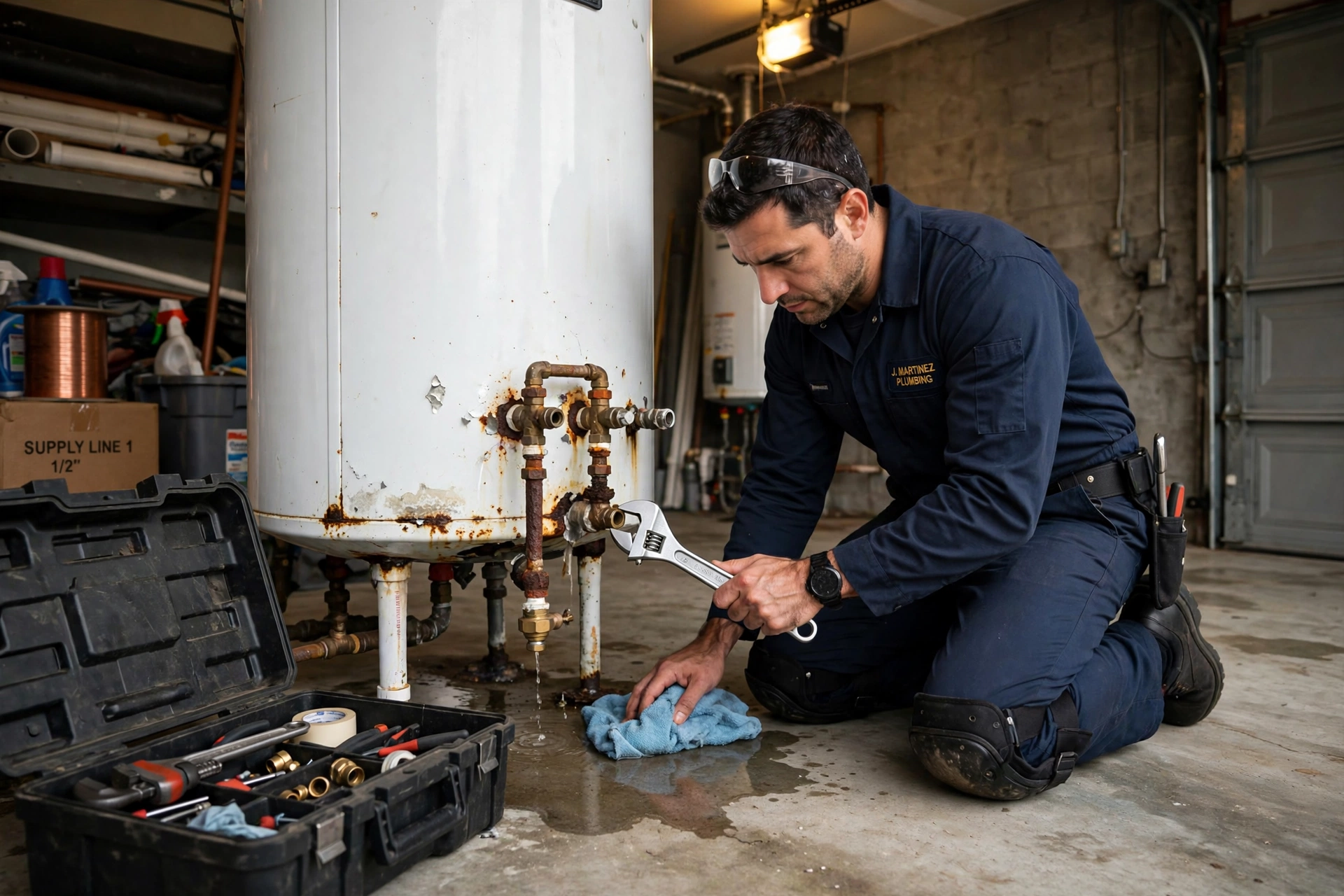
The box says 10–12 years. The national chart says 8–12. But neither was written for a garage in Goose Creek, where the air stays damp ten months a year and the water carries its share of minerals. Here is the honest math on heater lifespan in the Lowcountry — and the maintenance that moves your unit from the short end of the range to the long end.
On this page
The realistic Lowcountry range
A conventional tank water heater in Goose Creek typically delivers 8–12 years: 8–10 for neglected units, 10–12 for maintained ones. Tankless units run 15–20 years with descaling. The spread is almost entirely maintenance — the climate punishes neglect faster here than in drier states.
What humidity does to the outside
Constant damp air condenses on cold inlet piping and keeps the tank jacket, fittings, and gas connections wet. Exterior corrosion advances year-round instead of seasonally, attacking fittings and the tank's lower shell first. This is why Lowcountry heaters so often fail at connections while the tank interior still has life.
What local water does to the inside
Mineral content drops sediment that insulates the tank bottom, forcing longer burn cycles and hotter steel — which accelerates interior corrosion once the anode rod is spent. And in our warm water, anodes deplete faster than the manuals assume: plan on 3–5 years, not 5+.
The maintenance that actually extends life
Annual flushing removes the sediment blanket. Anode replacement on the Lowcountry schedule protects the interior. Valve inspections catch the exterior corrosion early. Together, these three habits are the difference between replacing at year 8 and year 12 — roughly $1,000+ in deferred cost per cycle.
When replacement beats another repair
Past year 10, price any major repair against replacement: a $400 repair on a 12-year tank buys uncertain months, while a new unit buys a decade with warranty. We show both numbers side by side — (833) 713-2101 for an honest assessment.
Need a pro? Get Your Free Estimate Today
Same-day appointments across Goose Creek and the Lowcountry.
Prefer to read first? Browse our guides or contact us.
Frequently asked questions
Does a water softener extend heater life here?
It reduces scaling significantly, which helps elements and reduces sediment. It does not stop exterior humidity corrosion — you still need the full maintenance routine.
My heater is 14 years old and fine — am I lucky or overdue?
Both. Some tanks beat the odds, but at 14 the risk curve steepens sharply. Start planning replacement on your schedule rather than the tank's.
Do tankless units really last longer?
Yes — 15–20 years is realistic with annual descaling, since there is no tank to corrode through. The heat exchanger still needs care in our mineral-heavy water.