 Water Heater Leak Repair Team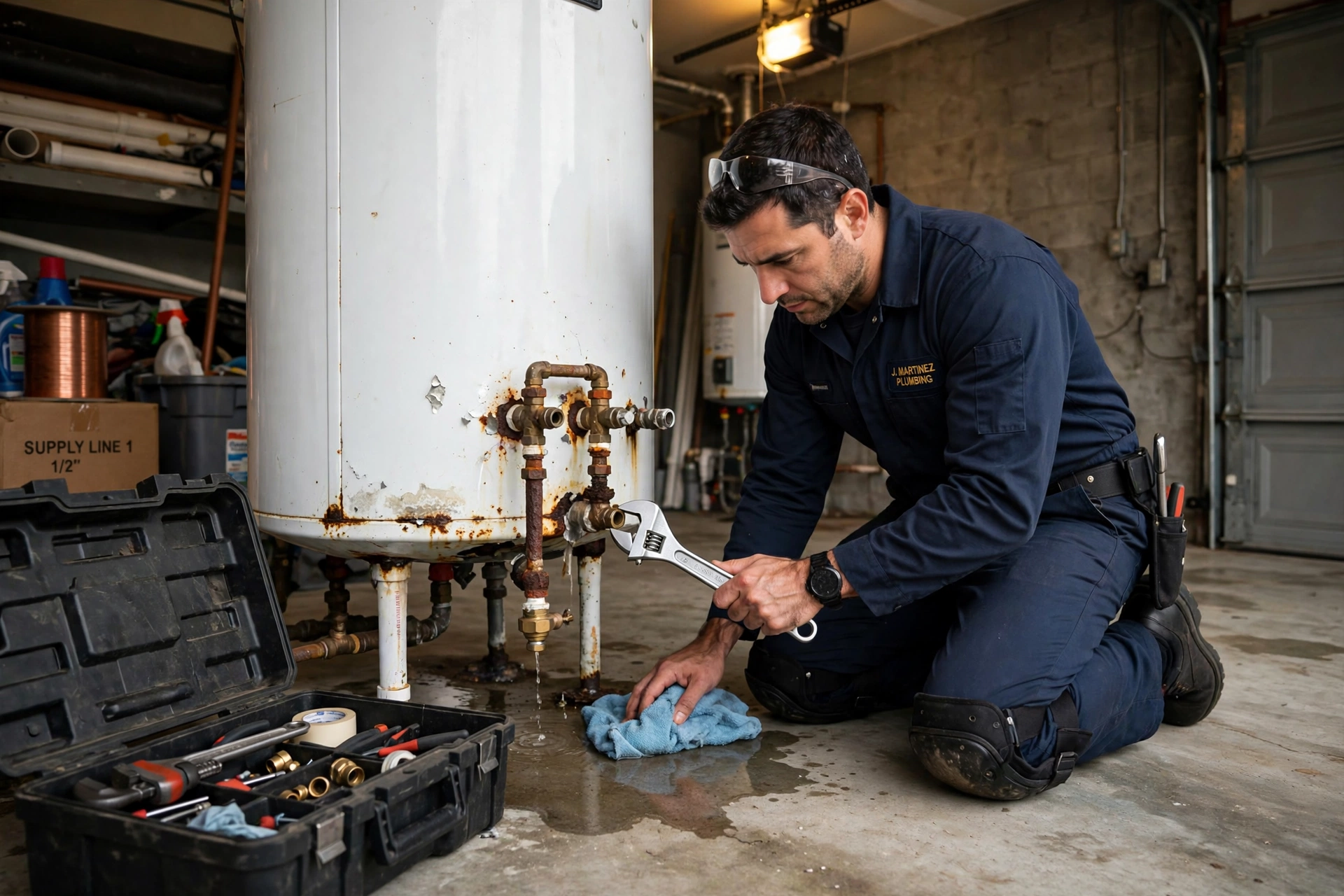
The tank-versus-tankless debate usually centers on endless hot water and energy bills. But for leak risk — the thing that actually damages homes — the two technologies fail in completely different ways, and Lowcountry humidity tilts the comparison in ways most articles ignore.
On this page
How tanks fail
Catastrophically, eventually. Forty to fifty gallons under pressure behind a steel shell: when interior corrosion wins, the tank splits and releases its contents in minutes. Warning signs exist (rusty water, weeping seams) but the failure mode is a flood. In our climate, 8–12 years is the honest tank lifespan.
How tankless units fail
Gradually, visibly — mostly. No stored volume means no 50-gallon flood; instead you get weeping service valves, condensate drain backups, and heat-exchanger seepage. The catch: the compact cabinet hides early drips, and our humidity supercharges condensate volume, making the condensate drain the number-one 'mystery leak' on Lowcountry tankless units.
The humidity factor
Tank exteriors corrode in damp garages; tankless condensate systems work overtime in damp air. It is roughly a wash on maintenance burden — tanks need anodes and flushing, tankless needs descaling and condensate care. Neither is 'set and forget' here.
Flood-risk comparison
For pure worst-case water damage, tankless wins decisively — there is simply less water to release. For slow-leak detection, tanks win slightly — a tank's drips are out in the open, while tankless weeps hide in the cabinet. A water alarm under either closes the gap.
Our recommendation for Goose Creek
Choose based on hot-water needs, space, and budget — not leak fear. Then mitigate: pans with drains and alarms for tanks; condensate maintenance and cabinet inspections for tankless. Either way, (833) 713-2101 keeps it dry.
Need a pro? Get Your Free Estimate Today
Same-day appointments across Goose Creek and the Lowcountry.
Prefer to read first? Browse our guides or contact us.
Frequently asked questions
Can I convert from tank to tankless?
Usually yes — $2,500–$5,500 depending on venting and gas or electrical upgrades. We assess feasibility on site and quote both options.
Do tankless units need a drain pan?
Code and common sense say protect the space below. Wall-hung units still weep, and condensate backups still overflow — a pan or a well-placed alarm is cheap sense.
Which costs less to maintain here?
Comparable over a decade: tanks need anodes and flushes, tankless needs descaling and condensate service. Ask us to model your specific situation.